Showing posts with label Sapere Books. Show all posts

Thursday, 10 January 2019

Book Review; the murder of Patience Brooke by JC Briggs

The Murder of Patience Brooke: Victorian London is full of dark secrets... (Charles Dickens Investigations Book 1) by [Briggs, J. C.]So, here’s my second book of the New Year, and a very good one it was, too. JC Briggs’ The Murder of Patience Brooke is the first in a series of historical mysteries with an intriguing premise — that Charles Dickens works with the police to solve a series of murders.

I’m not the world’s biggest Dickens fan, which doesn’t matter at all, and know very little about him, which possibly does given the references to his insecurities about his background and his uncertainty about his marriage. I felt there was a layer in this book that I’m rather missing out on; but maybe I’m wrong. And even if I’m not, there was plenty here to get stuck into as Dickens and his friend, Superintendent Sam Jones, set out to solve the mystery of the murder of virtuous and mysterious Patience Brooke, found gruesomely displayed outside the home for fallen women which Dickens established.

There was so much to enjoy in this book. The plot was engaging and gathered pace as our heroes began to run the villain to earth. The central characters were rounded and appealing and Dickens’ unhappy marriage (and large family) was cleverly contrasted with Jones’ happy, but childless, one. I did feel that many of the subsidiary characters were less rounded and more caricatured — though in fairness, that’s true of Dickens’ novels so maybe it was a deliberate nod to the master, even though that particular element didn’t work for me.

I had a few niggles. I found the writing a bit clunky in places, to the extent that it detracted from the dram of the closing scenes, and I was distracted by the use of ‘street speak’. (Is there really any value in using ‘sed’ for ‘said’ or ‘woz’ for ‘was’ when they sound the same?) And there was one point where a conversation referred to two different characters called Crewe and Carew, which had me momentarily confused.

It wasn’t the detectives who stole the show, though. It was Victorian London. The descriptions of the old city, its glories and it hell-holes, its sound and smells, its muffling fog, its early mornings and threatening darkness, were fantastic. If there was no other reason for me to read more in this series (and there are many), the setting alone would keep me going. London is the protagonist in this book, far more striking and capricious (and believable) even than Dickens himself.

Thanks to Netgalley and Sapere Book for a copy of this book, in return for an honest review.

Saturday, 1 December 2018

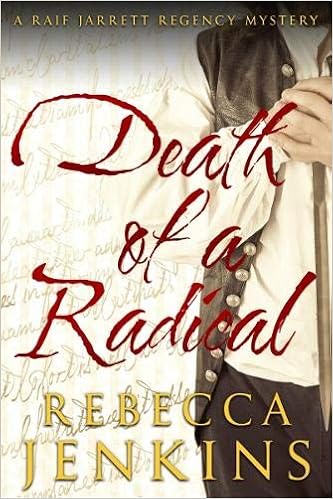
Death of a Radical by Rebecca Jenkins: Book Review

Death of a Radical is the second book in Rebecca Jenkins’s series of historical crime novels featuring Raif Jarrett, agent to the Duke of Penrith and veteran of the Peninsular War. I read and (on the whole) enjoyed the first one, certainly enough to want to persist with more of the same.

The second book has pretty much the same flaws as the first, plus an additional weakness and an additional strength, which leaves me ready to give a third book in the series a try though I won't be putting publication date in my diary. Jenkins writes well (overlooking the short sentences and head hopping, which are my pet peeves but not necessarily bad in themselves) and I think she knows it. The problem is that she doesn’t have the balance right. The book feels more about the writing than anything else and as a result, the action is obscured.

In a mystery the plot is crucial and the writing should enhance it, not obscure it. In this book there there were several occasions when I had to go back and reread a scene because I wasn’t sure exactly what happened — something I occasionally do if I’m tired and reading late at night, but don’t expect to do repeatedly when I’m reading of an afternoon. For me that blunted the excitement that the book ought to have, and made it quite a slow read — something that was amplified by the unnecessarily detailed descriptions of everything from the weather down to the colour of a lady’s ribbons. It was a nice enough read, I suppose — but I wanted more action from a book that sets itself out as a mystery.

Stripping away the writing leaves the plot a little bit exposed and this is the weakness that the first book didn’t have. The whole thing never quite held up for me: I would give examples, but can’t because of the risk of spoilers, though I can say that the connection between the various murders was never quite strong enough for me, and nor did I really understand exactly what the killings were all about. Again, it may be in there but I couldn’t find it under the elegant prose. (Sometimes there’s a value in plain speaking.) There seemed to be a lot of scenes which didn’t pull their weight in terms of advancing the story — something else which slowed the pace and made the book drag — although when Raif finally decided to take action, he did so dramatically and the conclusion was satisfying.

This feels a slightly mean-spirited review, so I’ll redress the balance with what I did like — the characters. I love the way Jenkins has set up the whole series. Raif is complex and fascinating, ideal protagonist material (even if he does spend rather too much time standing around not doing a lot) and his relationships with Charles, the Duke’s son and with Henrietta Lonsdale are nicely drawn. All the minor characters are fascinating, too, although perhaps we don’t need to see quite as much of all of them as we do in the book.

I don’t like giving stars and this book illustrates why. Do I rate it for its obvious qualities, or do I rate it for how I felt about it? I did like it, but at the same time I struggled to get through. Jenkins has created a wonderful set of characters who seem desperate to be set free from the weight of her description and allowed to act. It’s a good book, and well-written. As literary fiction it would be terrific, but somehow, as a mystery, it doesn’t quite deliver.

Thanks to Sapere Books and Netgalley for a copy of this book in return for an honest review.

Monday, 26 November 2018

Dear Laura by Jean Stubbs: Book review

Time for another book review, time for another classic mystery. Though actually I’m not sure that merely reissuing a detective novel, in this case from the 1970s, necessarily makes it a classic and to be honest some of the oldies have lasted better than others.

Perhaps I’m being a bit harsh on Dear Laura by Jean Stubbs, because it does have a lot to commend it. It’s a historical mystery set in late Victorian times. Wealthy but emotionally cold businessman Theodore Crozier is dead and his death wasn’t the result of natural causes — but was the overdose of morphine in his system accident or murder? Theodore’s relationship with his wife, Laura, is cold, distant and unemotional, and her relationship with his wayward younger brother, Titus, is anything but. The servants are divided and Inspector Lintott of Scotland Yard is there to unravel the mystery.

As I say, there’s a lot going for this book. It’s well-written and the characters are cleverly-drawn. The author paints a terrific picture of a society whose conventions force those of all classes to accept what is expected of them and illustrates that the rich can be as miserable as the poor. The plot is clever, with plenty of twists and turns, although for me it had a less than satisfactory conclusion, and I didn’t particularly like any of the characters, which can make a book a hard read.

Where it fell down for me is in the solving of the mystery. The book is the first in a series featuring Inspector Lintott but apart from whisking across the narrative very fleetingly early on, the detective doesn’t make an appearance until almost half way through. The rest of the book is scene-setting which, while necessary up to a point, seemed rather out of balance. And the investigation itself consisted of Lintott talking to everyone involved and coming to a conclusion — no spoilers but…

Perhaps it’s down to the expectation we have detective fiction but, for me, if the investigating officer is the main protagonist (and he or she has his name on the cover) then he or she needs to be at the heart of the book from the beginning. I thought there was too much back story and not enough detecting and, as a result, I couldn’t really engage with Inspector Lintott in the way I feel I was meant to.

Thanks to Sapere Books and Netgalley for a copy of this book, in return for an honest review.