Showing posts with label crime writing. Show all posts

Thursday, 10 January 2019

Book Review; the murder of Patience Brooke by JC Briggs

The Murder of Patience Brooke: Victorian London is full of dark secrets... (Charles Dickens Investigations Book 1) by [Briggs, J. C.]So, here’s my second book of the New Year, and a very good one it was, too. JC Briggs’ The Murder of Patience Brooke is the first in a series of historical mysteries with an intriguing premise — that Charles Dickens works with the police to solve a series of murders.

I’m not the world’s biggest Dickens fan, which doesn’t matter at all, and know very little about him, which possibly does given the references to his insecurities about his background and his uncertainty about his marriage. I felt there was a layer in this book that I’m rather missing out on; but maybe I’m wrong. And even if I’m not, there was plenty here to get stuck into as Dickens and his friend, Superintendent Sam Jones, set out to solve the mystery of the murder of virtuous and mysterious Patience Brooke, found gruesomely displayed outside the home for fallen women which Dickens established.

There was so much to enjoy in this book. The plot was engaging and gathered pace as our heroes began to run the villain to earth. The central characters were rounded and appealing and Dickens’ unhappy marriage (and large family) was cleverly contrasted with Jones’ happy, but childless, one. I did feel that many of the subsidiary characters were less rounded and more caricatured — though in fairness, that’s true of Dickens’ novels so maybe it was a deliberate nod to the master, even though that particular element didn’t work for me.

I had a few niggles. I found the writing a bit clunky in places, to the extent that it detracted from the dram of the closing scenes, and I was distracted by the use of ‘street speak’. (Is there really any value in using ‘sed’ for ‘said’ or ‘woz’ for ‘was’ when they sound the same?) And there was one point where a conversation referred to two different characters called Crewe and Carew, which had me momentarily confused.

It wasn’t the detectives who stole the show, though. It was Victorian London. The descriptions of the old city, its glories and it hell-holes, its sound and smells, its muffling fog, its early mornings and threatening darkness, were fantastic. If there was no other reason for me to read more in this series (and there are many), the setting alone would keep me going. London is the protagonist in this book, far more striking and capricious (and believable) even than Dickens himself.

Thanks to Netgalley and Sapere Book for a copy of this book, in return for an honest review.

Saturday, 1 December 2018

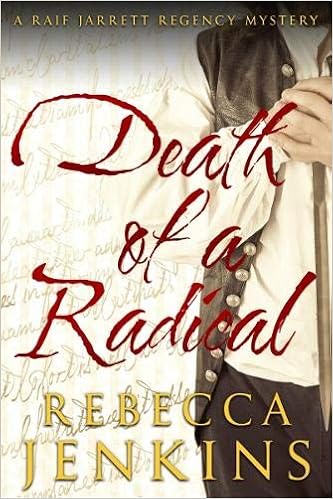
Death of a Radical by Rebecca Jenkins: Book Review

Death of a Radical is the second book in Rebecca Jenkins’s series of historical crime novels featuring Raif Jarrett, agent to the Duke of Penrith and veteran of the Peninsular War. I read and (on the whole) enjoyed the first one, certainly enough to want to persist with more of the same.

The second book has pretty much the same flaws as the first, plus an additional weakness and an additional strength, which leaves me ready to give a third book in the series a try though I won't be putting publication date in my diary. Jenkins writes well (overlooking the short sentences and head hopping, which are my pet peeves but not necessarily bad in themselves) and I think she knows it. The problem is that she doesn’t have the balance right. The book feels more about the writing than anything else and as a result, the action is obscured.

In a mystery the plot is crucial and the writing should enhance it, not obscure it. In this book there there were several occasions when I had to go back and reread a scene because I wasn’t sure exactly what happened — something I occasionally do if I’m tired and reading late at night, but don’t expect to do repeatedly when I’m reading of an afternoon. For me that blunted the excitement that the book ought to have, and made it quite a slow read — something that was amplified by the unnecessarily detailed descriptions of everything from the weather down to the colour of a lady’s ribbons. It was a nice enough read, I suppose — but I wanted more action from a book that sets itself out as a mystery.

Stripping away the writing leaves the plot a little bit exposed and this is the weakness that the first book didn’t have. The whole thing never quite held up for me: I would give examples, but can’t because of the risk of spoilers, though I can say that the connection between the various murders was never quite strong enough for me, and nor did I really understand exactly what the killings were all about. Again, it may be in there but I couldn’t find it under the elegant prose. (Sometimes there’s a value in plain speaking.) There seemed to be a lot of scenes which didn’t pull their weight in terms of advancing the story — something else which slowed the pace and made the book drag — although when Raif finally decided to take action, he did so dramatically and the conclusion was satisfying.

This feels a slightly mean-spirited review, so I’ll redress the balance with what I did like — the characters. I love the way Jenkins has set up the whole series. Raif is complex and fascinating, ideal protagonist material (even if he does spend rather too much time standing around not doing a lot) and his relationships with Charles, the Duke’s son and with Henrietta Lonsdale are nicely drawn. All the minor characters are fascinating, too, although perhaps we don’t need to see quite as much of all of them as we do in the book.

I don’t like giving stars and this book illustrates why. Do I rate it for its obvious qualities, or do I rate it for how I felt about it? I did like it, but at the same time I struggled to get through. Jenkins has created a wonderful set of characters who seem desperate to be set free from the weight of her description and allowed to act. It’s a good book, and well-written. As literary fiction it would be terrific, but somehow, as a mystery, it doesn’t quite deliver.

Thanks to Sapere Books and Netgalley for a copy of this book in return for an honest review.

Saturday, 13 October 2018

Review: A Snapshot of Murder by Frances Brody


Cosy historical mysteries are back in fashion, and my goodness, does that make me happy. I love the classics of 1930s crime — Dorothy Sayers and Ngaio Marsh are my favourites — and I went into raptures a couple of years back when publishers began reprinting other books of that era. 

The cosy historical was, I suppose, the next logical step, and I can’t get too many of them. A Snapshot of Murder is the tenth in the Kate Shackleton series by Frances Brody, and it’s the second I’ve read. (You don’t need to read them in order, which is fine by me.) Set in the 1920s, the books feature war widow Kate Shackleton, who runs an investigative agency.

In A Snapshot of Murder, members of the local camera club (Kate lives in Leeds) set off to Haworth, for the opening of the Bronte Parsonage Museum…but one of them doesn’t make it home alive. It’s difficult to review crime novels without giving spoilers, so I won’t say any more, other than that there were twists and turns aplenty and a satisfying conclusion (though there was one loose end left untied, which still troubles me a little).

There was a huge amount to love about the book. In particular, I adored the settings and the historical detail. I don’t know the Haworth area well, I’ve been there recently enough to recognise many of the places, but even if I hadn’t the description would have given me a clear idea of what it’s like. And the author used real locations, too, so that I could follow the action on the map. (Yes, I like to do that when I’m reading.)

I mostly liked the characterisation, though I did have a problem wth Kate herself — odd, because although there are several points of view, she’s the only one in first person. This ought to make her more accessible, but somehow it doesn’t. As in the previous book I read, I found myself failing to warm to her, or sense any emotional engagement, even when she looked at photographs of her late husband, or came face-to-face with the man whose marriage proposal she had previously turned down. 

I like to live the story with my protagonist, especially if they’re written in first person, and I felt that I was always looking at Kate from the outside. I suspect that may be what the author intends, because scenes from the point of view of others — unhappy wife Carine, for example, and Kate’s uber-enthusiastic niece Harriet — were much more engaging. But I wish I’d warmed to Kate rather more than I did.

I think it was this, together with the short sentences which gave the whole book a slightly clipped tone, that hold me back from raving about it. That’s a personal view, of course, and in all other ways it was a terrific, clever and engaging book. I’ll certainly be reading more of the series.  

I received this book from Netgalley/Little, Brown in return for an honest review.

Saturday, 6 October 2018

A Crime Update

Grave matter in the Lake District...
Time for an update, though if you follow me on any of my social media you probably won’t need it. It was on 24 September last year that I announced my decision to switch genres and write crime and it was on 18 September this year that I had confirmation that Aria Fiction wanted to publish the first three in my crime series.

What a year that’s been.

I’m not going to repeat the story of how I began to write crime. It’s up on the blog and you can scroll back through if you’re interested. But I wanted to use this blog entry to encourage anyone else never to give up.

The reason I didn’t write crime was that I thought I wasn’t good enough. I thought it was too difficult. I thought the plotting was too complex and it would be impossible to keep readers interested in so many characters, that handling several points of view was beyond my capability.

And here’s the thing. It was almost certainly true.

I’ve been writing for ever. When I first started I almost certainly couldn’t have handled the crime genre. Let’s face it, when I first started writing I couldn’t handle any other genre. I had too much to learn. I did have a couple of stabs at thrillers but they were woeful, so woeful that even in my naive innocence I knew it. So I wrote romance, not because I thought it was easier — anything but —  but because the structure of it is simpler.

I liked writing romance. I still do, and it was the genre in which I was first published. But I couldn’t help myself and I shifted to romantic suspense, which involved a crime alongside a love story. And that’s how I became a crime writer. Without realising it.

But the message is this. It took me years to develop the skills to tackle writing a publishable novel, in any genre. I have a cupboard full of unfinished (or finished but unreadable) manuscripts to prove it, the carcases of good ideas that died on the long march to my dream.

There was no instant revelation, no stepping into crime and suddenly realising that I’d found my genre. The truth is that once I’d assembled my writer’s toolkit I could apply it to anything. Because the fundamentals of writing a good story are the same in any genre. I didn’t become a crime writer overnight. I became a crime writer because I practised and practised and practised. 

My advice to any aspiring writer is to do write and to keep writing. The chances are that most of your early work will fall way short of being publishable (there are exceptions). But writing is a craft. Give it everything. You won’t regret it.