Showing posts with label cosy historical mystery. Show all posts

Thursday, 11 April 2019

Book Review: Wakenhyrst by Michelle Paver

On a long train journey over the weekend I sat down with Michelle Paver’s Wakenhyrst, and I devoured it at one go.

There. That’s probably all you need to know but I feel I ought to make a bit more of an effort to tell you what I loved about it, and the book certainly deserves it. It’s a complex, compelling, dark, twisted, wonderful, readable book.

It’s set in the early part of the twentieth century and it’s the story of Maud, a child when the story begins. Stuck in a house on the edge of the fens with a wealthy but eccentric father, an irritating younger brother (who, being a boy, is granted seniority) and a long-suffering mother whose endless pregnancies almost all seemed destined to end in miscarriage or death, Maud has a grim coming of age.

I quote from the blurb. “When [her father] finds a painted medieval devil in a graveyard, unhallowed forces are awakened. Maud's battle has begun. She must survive a world haunted by witchcraft, the age-old legends of her beloved fen – and the even more nightmarish demons of her father's past.”

There was so much to love about this book. The sinister fenland with its lingering spirits is drawn as a place that would drive anyone mad. Even Maud, a practical young woman, begins to believe in evil things that creep around the corridors of Wake’s End, the house, at night. The characterisation is wonderful, the story telling extraordinary, so that I was drawn into it and just kept reading and reading and reading.

If there was one thing I didn’t like about it, it was the prologue and epilogue that brought the story into the 1960s. Yes, there was information there that tied up the loose ends of the story, but I didn’t feel it was necessary and slightly weakened the whole thing for me. Not much, though, and certainly not enough to stop me recommending it to anyone looking for a darkly satisfying read.

Thanks to Netgalley and Head of Zeus for a copy of this book in return for an honest review.

Wednesday, 13 March 2019

Murder in Park Lane by Karen Charlton: Book Review

Murder in Park Lane (The Detective Lavender Mysteries Book 5) by [Charlton, Karen]I keep promising myself I’m going to kick my cosy mystery habit and move on to something edgier instead, but somehow I never do. My latest read, Karen Charlton’s Murder in Park Lane, did nothing to make me want to look elsewhere. 

The book is set in London in 1812 and it’s the fifth in a series featuring Inspector Lavender and his sidekick Ned Woods, but it worked very well as a standalone. So many series writers slip up here, but Charlton has it spot on — just the right amount of backstory, enough hints about past mysteries to nudge the reader towards them without leaving you feeling that you’ve missed out, and yet she manages to engage the reader with her recurring characters (though I would guess there are only two detectives, so there’s not a huge amount of room for confusion).

There’s murder afoot, in fashionable Mayfair, where a man has been found mysteriously dead inside a locked room with no murder weapon. This intriguing premise was perhaps solved rather earlier than I would have liked, but the mystery took off nicely, full of twists and turns as people’s secrets were revealed. Lavender and Woods are hot on the trail, though, relentlessly picking their way through the mysteries of the wealthy and the titled, the poor, the moneylenders and the fraudsters until they reach a satisfying conclusion.

For the most part I loved the characterisation, which was neat and anything but cliched, and I laughed out loud at some of the turns in the book (such as the nymphomaniac elderly ladies with an eye for handsome young men). I wasn’t so taken with the subplot of Woods deciding he was overweight and fasting to the detriment of his health, which was something that felt far more like the behaviour of a teenage girl than of a policeman with an adult child. It was so odd that I assumed it must have something to do with the plot, but it didn’t and rather petered out.

That one gripe aside, I thoroughly enjoyed this book and will definitely be going back to read more in the series. 

Thanks to Amazon Publishing UK and Netgalley for a copy of this book in return for an honest review. 

Sunday, 27 January 2019

A Front Page Affair by Rhada Vatsal: Book Review

A Front Page Affair: A Kitty Weeks Mystery by [Vatsal, Radha]Anyone who knows me knows I love a cosy mystery. If they know me really well, they might know that the things I like most are complex, engaging characters, a believable setting and a good plot. In this respect, Rhada Vatsal’s A Front Page Affair, partly delivers.

Kitty (real name Capability) Weeks is a New York socialite in the early months of the First World War. Europe is getting deeper into conflagration and America is poised on the edge of war. Kitty, an aspiring journalist with the society pages of a New York newspaper, is sent to cover a party at an uptown country club, only to find herself witness to murder — and of course, she’s determined to track the killer down.

I very much wanted to like this book, and it does have a lot going for it. It has a clever setting and fictional events are cleverly woven in with actual historical ones. The plot was clever, focussing on the diplomatic manoeuvrings around America’s potential entry into the war, and there were twists and turns aplenty, although, if I’m honest, some of them stretched my credibility a little bit too far (no spoilers, but surely no FBI agents would allow a member of the public along on a mission to intercept a killer just because she happened to be interested in the case).

So far, so good, but the element of the book the rather disappointed me was the characterisation. For me, any book has to be driven by the characters. I want to feel engaged by them. I want to care about them. In this book, I didn’t, and the end result was that I felt the whole thing was rather superficial. Characters came and went. There was no depth to them, no complications. Kitty herself was a spoiled rich girl and never really stopped to think about anything, except in passing. The minor characters, too, weren’t clearly drawn in terms of character (describing someone’s external appearance is only part of it) and, for example, all the FBI agents tended to merge into one in my head as I read.

I realise I’m being fussy, here, and other people may look for different things from a book. It’s not a bad book, by any means, but just one that didn’t give me what I’m looking for from a cosy novel. If you want a pacy, light read with a few twists and  lot of fascinating (real-life) background about New York in 1915, then this is definitely your book, even if it wasn’t mine.

Thursday, 24 January 2019

Book Review: Death at Hungerford Stairs by JC Briggs

Death at Hungerford Stairs: A serial killer is on the loose in Victorian London (Charles Dickens Investigations Book 2) by [Briggs, J. C.]This is the second in the series by JC Briggs with Charles Dickens (yes, that one) as the protagonist. In Death at Hungerford Stairs, Dickens and his friend, police superintendent Sam Jones, are searching for Scrap, a missing friend of theirs who lives on the streets. The body that’s discovered in the old blacking factory at Hungerford Stairs isn’t the boy they were searching for, but a stranger — and he’s been murdered. Later, another dead boy appears, killed in the same manner, and the chase is on to find the killer — and save Scrap.

I enjoyed this book very much, just as I did the first in the series, though I have to say the weaknesses are the same. On the plus side, I really loved the insight into Victorian London and the way the squalor of its poorer quarter sits side-by-side with (but overlooked by) areas of extreme wealth and opulence. Again, I think the author’s scene-setting is exceptional and felt that I was walking through London of the 1850s.

Like Dickens himself, Briggs seems to separate the minor characters, who are pretty much caricatures, from the major ones. Dickens, Sam Jones, Jones’s wife and some others feel very real, people with feelings and emotions and complex back stories (though we see a little less of them than we did in the first book, which is a bit of a shame).

The minor caricatures are all faintly comic, identifiable by street speech, odd appearance and strange names— Occy Graves, Zeb Scruggs and so on. They have back stories, too, but the telling of them, often in story form in the dialogue, doesn’t allow us the same kind of insight that we do when we’re allowed to live lives with them, as we are with Dickens and with Jones. The downside is that I couldn’t connect with them in the same way, and that was a pity because (no spoilers) even at the moment of highest drama, I was left largely unmoved by the fate of the characters involved.

I enjoyed the plot, too, though it was perhaps a little bit slender and didn’t really involve a huge amount of detecting. But it had a satisfactory ending and one which I didn’t guess.

I’d definitely read more by the same author, and this gets a solid four stars. But much as I love the description I do think less is more and I’d have sacrificed some of it for a little more plot and some deeper characterisation.

The things I don’t really like about this book are the things I don’t really like about Dickens’ works, which is something I hope the author will take as a compliment. Fans of the great man will love it, I suspect.

Thanks to Sapere Books and Netgalley for a copy of this book in return for an honest review.

Wednesday, 16 January 2019

Murder Under a Green Sea by Philip Hunter: book review

I love a good historical murder mystery and I’m generally quite forgiving of the odd eccentricity. That said, I have to confess to mixed feelings about Philip Hunter’s Murder Under a Green Sea. It ought to be right up my street. Set in 1937, with war on the horizon, it focuses in on Max and his wife Martha. Martha is very rich and Max, who has a very humble background, is poor. When members of Max’s old platoon from the first World War start dying in suspicious circumstances and Max is the prime suspect, the two of them set out to try and solve the mystery.

What was so problematic? There were  couple of things. The first was that it was very slow to start. For much of the opening I ploughed on through bits of story that seemed at best unnecessary and at worst silly. There was a dinner party scene that seemed to go on as long as the dinner party itself and, although it later emerged that some of what went on there was germane to the later plot development, it could have been done a lot more quickly and a lot more snappily. And, bluntly, the same thing could have been achieved with better (for which read more subtle) development of the characters.

Fortunately I have staying power. I hung in there and when the plot finally took off it was (apart from the odd little niggle) pretty good — very Boy’s Own in places, to the point of stretching my credibility, but nevertheless it was fast-moving and exciting. (Though I’m sorry — I identified the villain very early on, though not the motive.)

I liked the set-up very much, with Max’s insecurity balanced against his wife’s self-confidence and, beneath it all, a tender love story between the two. The rest of the characters weren’t so good, though — I think that’s why the action felt, in places, little bit beyond my credibility.

The big problem I had with it was tone. As so often the case it’s a subjective thing, but I didn’t feel the flippancy of the overall style was in keeping with the plot and, as a consequence, it undermined my enjoyment of the whole story. It’s a great plot and I wanted to get on with it. The author’s constant flippant asides irritated me intensely when, if he’d kept his humour to the characters (their speech and their actions) he might have got away with it.

It’s a good book if you like your thrillers flippant, which I don’t, but it’s the plot that saves it — though I’d very much like to have got into the plot a lot earlier.

Thanks to Netgalley and Mirror Books for a copy of this book in return for an honest review.

Thursday, 10 January 2019

Book Review; the murder of Patience Brooke by JC Briggs

The Murder of Patience Brooke: Victorian London is full of dark secrets... (Charles Dickens Investigations Book 1) by [Briggs, J. C.]So, here’s my second book of the New Year, and a very good one it was, too. JC Briggs’ The Murder of Patience Brooke is the first in a series of historical mysteries with an intriguing premise — that Charles Dickens works with the police to solve a series of murders.

I’m not the world’s biggest Dickens fan, which doesn’t matter at all, and know very little about him, which possibly does given the references to his insecurities about his background and his uncertainty about his marriage. I felt there was a layer in this book that I’m rather missing out on; but maybe I’m wrong. And even if I’m not, there was plenty here to get stuck into as Dickens and his friend, Superintendent Sam Jones, set out to solve the mystery of the murder of virtuous and mysterious Patience Brooke, found gruesomely displayed outside the home for fallen women which Dickens established.

There was so much to enjoy in this book. The plot was engaging and gathered pace as our heroes began to run the villain to earth. The central characters were rounded and appealing and Dickens’ unhappy marriage (and large family) was cleverly contrasted with Jones’ happy, but childless, one. I did feel that many of the subsidiary characters were less rounded and more caricatured — though in fairness, that’s true of Dickens’ novels so maybe it was a deliberate nod to the master, even though that particular element didn’t work for me.

I had a few niggles. I found the writing a bit clunky in places, to the extent that it detracted from the dram of the closing scenes, and I was distracted by the use of ‘street speak’. (Is there really any value in using ‘sed’ for ‘said’ or ‘woz’ for ‘was’ when they sound the same?) And there was one point where a conversation referred to two different characters called Crewe and Carew, which had me momentarily confused.

It wasn’t the detectives who stole the show, though. It was Victorian London. The descriptions of the old city, its glories and it hell-holes, its sound and smells, its muffling fog, its early mornings and threatening darkness, were fantastic. If there was no other reason for me to read more in this series (and there are many), the setting alone would keep me going. London is the protagonist in this book, far more striking and capricious (and believable) even than Dickens himself.

Thanks to Netgalley and Sapere Book for a copy of this book, in return for an honest review.

Saturday, 1 December 2018

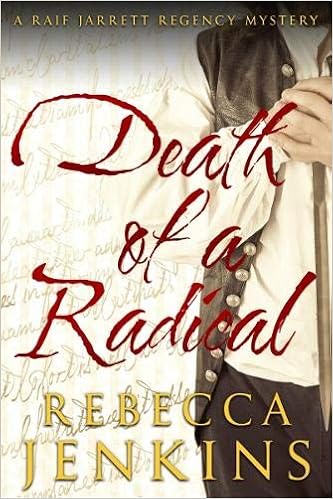
Death of a Radical by Rebecca Jenkins: Book Review

Death of a Radical is the second book in Rebecca Jenkins’s series of historical crime novels featuring Raif Jarrett, agent to the Duke of Penrith and veteran of the Peninsular War. I read and (on the whole) enjoyed the first one, certainly enough to want to persist with more of the same.

The second book has pretty much the same flaws as the first, plus an additional weakness and an additional strength, which leaves me ready to give a third book in the series a try though I won't be putting publication date in my diary. Jenkins writes well (overlooking the short sentences and head hopping, which are my pet peeves but not necessarily bad in themselves) and I think she knows it. The problem is that she doesn’t have the balance right. The book feels more about the writing than anything else and as a result, the action is obscured.

In a mystery the plot is crucial and the writing should enhance it, not obscure it. In this book there there were several occasions when I had to go back and reread a scene because I wasn’t sure exactly what happened — something I occasionally do if I’m tired and reading late at night, but don’t expect to do repeatedly when I’m reading of an afternoon. For me that blunted the excitement that the book ought to have, and made it quite a slow read — something that was amplified by the unnecessarily detailed descriptions of everything from the weather down to the colour of a lady’s ribbons. It was a nice enough read, I suppose — but I wanted more action from a book that sets itself out as a mystery.

Stripping away the writing leaves the plot a little bit exposed and this is the weakness that the first book didn’t have. The whole thing never quite held up for me: I would give examples, but can’t because of the risk of spoilers, though I can say that the connection between the various murders was never quite strong enough for me, and nor did I really understand exactly what the killings were all about. Again, it may be in there but I couldn’t find it under the elegant prose. (Sometimes there’s a value in plain speaking.) There seemed to be a lot of scenes which didn’t pull their weight in terms of advancing the story — something else which slowed the pace and made the book drag — although when Raif finally decided to take action, he did so dramatically and the conclusion was satisfying.

This feels a slightly mean-spirited review, so I’ll redress the balance with what I did like — the characters. I love the way Jenkins has set up the whole series. Raif is complex and fascinating, ideal protagonist material (even if he does spend rather too much time standing around not doing a lot) and his relationships with Charles, the Duke’s son and with Henrietta Lonsdale are nicely drawn. All the minor characters are fascinating, too, although perhaps we don’t need to see quite as much of all of them as we do in the book.

I don’t like giving stars and this book illustrates why. Do I rate it for its obvious qualities, or do I rate it for how I felt about it? I did like it, but at the same time I struggled to get through. Jenkins has created a wonderful set of characters who seem desperate to be set free from the weight of her description and allowed to act. It’s a good book, and well-written. As literary fiction it would be terrific, but somehow, as a mystery, it doesn’t quite deliver.

Thanks to Sapere Books and Netgalley for a copy of this book in return for an honest review.

Monday, 26 November 2018

Dear Laura by Jean Stubbs: Book review

Time for another book review, time for another classic mystery. Though actually I’m not sure that merely reissuing a detective novel, in this case from the 1970s, necessarily makes it a classic and to be honest some of the oldies have lasted better than others.

Perhaps I’m being a bit harsh on Dear Laura by Jean Stubbs, because it does have a lot to commend it. It’s a historical mystery set in late Victorian times. Wealthy but emotionally cold businessman Theodore Crozier is dead and his death wasn’t the result of natural causes — but was the overdose of morphine in his system accident or murder? Theodore’s relationship with his wife, Laura, is cold, distant and unemotional, and her relationship with his wayward younger brother, Titus, is anything but. The servants are divided and Inspector Lintott of Scotland Yard is there to unravel the mystery.

As I say, there’s a lot going for this book. It’s well-written and the characters are cleverly-drawn. The author paints a terrific picture of a society whose conventions force those of all classes to accept what is expected of them and illustrates that the rich can be as miserable as the poor. The plot is clever, with plenty of twists and turns, although for me it had a less than satisfactory conclusion, and I didn’t particularly like any of the characters, which can make a book a hard read.

Where it fell down for me is in the solving of the mystery. The book is the first in a series featuring Inspector Lintott but apart from whisking across the narrative very fleetingly early on, the detective doesn’t make an appearance until almost half way through. The rest of the book is scene-setting which, while necessary up to a point, seemed rather out of balance. And the investigation itself consisted of Lintott talking to everyone involved and coming to a conclusion — no spoilers but…

Perhaps it’s down to the expectation we have detective fiction but, for me, if the investigating officer is the main protagonist (and he or she has his name on the cover) then he or she needs to be at the heart of the book from the beginning. I thought there was too much back story and not enough detecting and, as a result, I couldn’t really engage with Inspector Lintott in the way I feel I was meant to.

Thanks to Sapere Books and Netgalley for a copy of this book, in return for an honest review.

Saturday, 13 October 2018

Review: A Snapshot of Murder by Frances Brody


Cosy historical mysteries are back in fashion, and my goodness, does that make me happy. I love the classics of 1930s crime — Dorothy Sayers and Ngaio Marsh are my favourites — and I went into raptures a couple of years back when publishers began reprinting other books of that era. 

The cosy historical was, I suppose, the next logical step, and I can’t get too many of them. A Snapshot of Murder is the tenth in the Kate Shackleton series by Frances Brody, and it’s the second I’ve read. (You don’t need to read them in order, which is fine by me.) Set in the 1920s, the books feature war widow Kate Shackleton, who runs an investigative agency.

In A Snapshot of Murder, members of the local camera club (Kate lives in Leeds) set off to Haworth, for the opening of the Bronte Parsonage Museum…but one of them doesn’t make it home alive. It’s difficult to review crime novels without giving spoilers, so I won’t say any more, other than that there were twists and turns aplenty and a satisfying conclusion (though there was one loose end left untied, which still troubles me a little).

There was a huge amount to love about the book. In particular, I adored the settings and the historical detail. I don’t know the Haworth area well, I’ve been there recently enough to recognise many of the places, but even if I hadn’t the description would have given me a clear idea of what it’s like. And the author used real locations, too, so that I could follow the action on the map. (Yes, I like to do that when I’m reading.)

I mostly liked the characterisation, though I did have a problem wth Kate herself — odd, because although there are several points of view, she’s the only one in first person. This ought to make her more accessible, but somehow it doesn’t. As in the previous book I read, I found myself failing to warm to her, or sense any emotional engagement, even when she looked at photographs of her late husband, or came face-to-face with the man whose marriage proposal she had previously turned down. 

I like to live the story with my protagonist, especially if they’re written in first person, and I felt that I was always looking at Kate from the outside. I suspect that may be what the author intends, because scenes from the point of view of others — unhappy wife Carine, for example, and Kate’s uber-enthusiastic niece Harriet — were much more engaging. But I wish I’d warmed to Kate rather more than I did.

I think it was this, together with the short sentences which gave the whole book a slightly clipped tone, that hold me back from raving about it. That’s a personal view, of course, and in all other ways it was a terrific, clever and engaging book. I’ll certainly be reading more of the series.  

I received this book from Netgalley/Little, Brown in return for an honest review.