Wednesday, 29 May 2019

Book Review: The Gentle Art of Tramping by Stephen Graham

Sometimes it’s hard to know what to make of a book. And reading Stephen Graham’s The Gentle Art of Tramping, in which he advises the would-be “tramp” (or long-distance walker, as we’d now describe it) on how to go about their business certainly gave me pause for thought.

Don’t get me wrong. On balance I think I liked it. But the truth is that some book are timeless and some books can become dated, and this is definitely one of the latter. So how do you judge it? As a historical piece, a window into a mindset of the time between the wars? (It was first published in, I think, 1926.) Or with a modern eye, a social conscience that can’t help twitching at some of the post-Imperial, overly-class conscious observations?

Graham makes a clear distinction between types of tramp — there are those like him, middle-class and seeking to escape the rat race, and there are the good-for-nothing hobos who can’t be trusted. (When the former helps himself to an apple from your orchard, by the way, it’s scrounging; when the latter does it it’s theft.) This is the problem I had — that a number of his attitudes and observation made me cringe, as if I’m listening to that old uncle complaining about the old days and how much better they were.

On reflection, though, I’ll judge it for its original intention. It captures a desire for freedom and communing with nature. It’s shaded with the echoes of the First World War, its end less than a decade old, and the restlessness of the new world comes through. It’s very readable and Graham’s whimsical humour appeals as he offers advice on what to take, where to walk and how to avoid getting into trouble in the less salubrious parts of the world.

As a book it describes a wider restlessness, a frustration in which one was “identified by one’s salary or by one’s golf handicap”. For all its occasional crassness (to modern readers at least) I enjoyed it.

Thanks to Bloomsbury and Netgalley for a copy of this book in return for an honest review.

Saturday, 11 May 2019

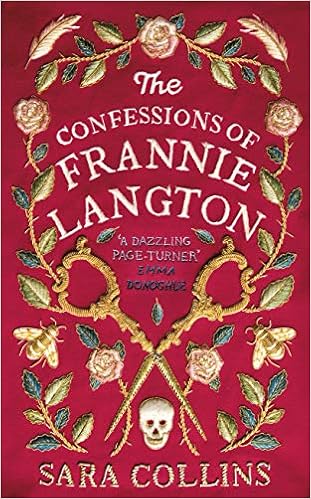
Book Review: The Confessions of Frannie Langton by Sara Collins


Content-wise Sara Collins’s The Confessions of Frannie Langton has just about everything — drama, passion, violence, murder, opiates, illegitimacy, mixed-race relationships (a big no-no in nineteenth century London), lesbianism (ditto) and more. It was a whirling dervish of a journey from Jamaican slave plantations to Newgate Gaol via luxurious London mansions and the whorehouse. 

If I had to pick a single theme from it I couldn’t. It touches on education, on racism, on scientific ethics, on forbidden love, on the oppression of women regardless of their race or class, and on more besides. It’s rich and it’s complex. In summary, the story is that of Frances Langton, mulatto maid to a London couple, on trial for their murder, and the story unwinds through her confession, the story of her life. Frances can’t defend herself because she has no memory of the events that led up to the crime and it’s only by unpicking her life that she comes to understand.

I feel in my head that this is a very good book, but somehow my heart just didn’t buy into it. Perhaps it’s because it’s so complex that it becomes bewildering, or perhaps it’s because I found the central part of it slow. And while the characters were all brilliantly drawn — no, exposed — I didn’t find any of them likeable. Even Frannie herself, a strong woman and a heroine I feel I should be rooting for, was someone I couldn’t quite engage with as much as I wanted to. 

There’s a lot to commend the book. The writing is powerful, though I thought it could have been pared down in certain places, and the scene-setting is lavish, bringing the smell of the burning sugar cane plantation into my nostrils, the sweaty claustrophobia of Newgate prison into my living room. The issues are important. But somehow, for me, the chemistry wasn’t quite there and the whole was less than the sum of its parts.

But don’t be put off. I think it’s a better book than I’m giving it credit for. 

Thanks to Netgalley and Penguin Books for a copy in return for an honest review. 

Book Review: Underland by Robert Macfarlane


Underland: A Deep Time Journey by [Macfarlane, Robert]There’s no getting away from it: Robert McFarlane’s Underland is a book as rich and complex as the underground world it describes. 

In many ways it’s an extraordinary book, a fascinating exploration of what lies beneath out feet. Some of the world he explores is man-made, some of it is natural; some of it is good and some of it quivering with evil like a Bond villain’s lair. 

“From the vast below-ground mycelial networks by which trees communicate, to the ice-blue depths of glacial moulins, and from North Yorkshire to the Lofoten Islands,” says the blurb, “he traces an uncharted, deep-time voyage. Underland a thrilling new chapter in Macfarlane's long-term exploration of the relations of landscape and the human heart.”

I loved it. I’m a fan of nature writing at the best of times, though sometimes it can be a bit slow. There are a couple of Macfarlane’s other books that I haven’t quite finished — not because they aren’t good but in much the same way as it’s sometimes hard to finish an incredibly rich dessert, so rich that you just can’t manage to eat any more, no matter how much you want to. 

Underland doesn't fall into this trap, largely because the worlds he describes are so powerful in themselves. He visits some worlds I’ve heard of and others I had no idea existed. He looks at cave paintings and the crazy urban life of the explorers of the Parisian catacombs, he goes scrambling down crevasses in melting glaciers and into mines and cave systems. 

There are, admittedly, one or two places where the writing felt a little pretentious and I really wanted him to stop listening to the sound of his own voice and get on with the plot (because although it’s non-fiction it definitely had the power of a story). But overall it’s a compelling read and I would recommend it to anyone. 

Thanks to Netgalley and Penguin Books for a copy of this book in return for an honest review. 
Sunday, 5 May 2019

A Hero on Mt St Helens by Melanie Holmes: Book Review

Anyone who has any real interest in volcanoes will know of the cataclysmic eruption of Mt St Helens in 1980. I have a bit more than a passing knowledge as my academic background is one of Earth science, so Melanie Holmes’ A Hero on Mt St Helens is a book that immediately resonated with me.

It’s a biography of David Johnston, a volcanologist with the United States Geological Survey, who happened to be on duty on a ridge overlooking the volcano when it erupted, killing not only Johnston but but fifty-odd other individuals unfortunate enough to be within the danger area (which turned out to be far beyond that which the USGS had forecast).

The book is a biography of Johnston, calling on memories of his friends, writings from his diaries and so on, and in a way it’s a strange book. Johnston, risking his life to monitor the volcano was a hero by chance. A day later, even a few hours later, and someone else would have been in his place. Then I might well be reviewing a biography of someone else entirely.

On that basis you can argue that Johnston wasn’t heroic, but in a way he is Everyman. He represents all of those who take on such a dangerous task to protect us from potential natural hazards, and although much of his life is unremarkable it’s the very ordinariness of his background that helps to show how easily, and by chance, ordinary, dedicated scientists can become heroes. 

In addition to to the minutiae (I would even say trivia) of Johnston’s life, the book contains a wealth of information about Mt St Helens and other volcanoes, about volcanic hazards and the personal stories of other volcanologists.

Because I’ve studied something of the discipline and keep myself up to date on what’s going on in the field, much of this wasn’t new to me. But for anyone who is interested but doesn’t know much about the topic, the story of David Johnston, an accidental hero, is fascinating, informative and in the end, useful. I thoroughly recommend it.

Thanks to Netgalley and the University of Illinois Press for a copy of this book in return for an honest review.

Monday, 22 April 2019

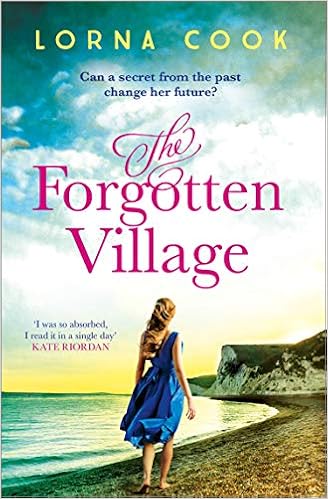
Review: The Forgotten Village by Lorna Cook

Over the Bank Holiday weekend I thoroughly enjoyed reading Lorna Cook’s novel The Forgotten Village. The book is set in the village of Tyneham in Dorset, which was requisitioned during the Second World War and the villagers were evicted, never to return, and has a dual timeline.

One story plays out during the last days of Tyneham as the villagers prepare to move out and Lady Veronica looks to seize her only chance to escape from her violent and brutal husband, Sir Bertie — only to be thwarted at the last minute by the arrival of Bertie’s brother. In the present, newly-single Melissa and handsome celebrity historian Guy meet for the first time on a visit to the forgotten village, find a photograph of the old days and set out to track down the story behind it.

The concept — dual timeline, lost village, past secret unearthed in the present — isn’t original but I did find Lorna Cook’s telling of her tale appealing. The older story had everything. There was drama, there was passion, there was betrayal, there was death, all playing out against the background of war and a sense of impending doom.

The present day story couldn’t hope to match it, and for me the book suffered a little from that, as Melissa and Guy’s tribulations seemed very frivolous compared to those that had gone before. I’m afraid I didn’t really engage with either of them in the way I did with the hapless Lady Veronica and I tended to race through the modern scenes to focus on the compelling story in the past.

The book bills itself as: “the most gripping, heartwrenching page-turner of summer 2019” and I felt that it was overselling itself a little. The way one story overshadowed the other made it feel a little unbalanced: I would have liked a little more action — and drama — in the present. Melissa’s relationship problems passed with little more than a shouting match and a lot of internal agonising while Guy’s (I can’t give detail without spoilers) mostly played out off the page.

So in short, I think I would have liked an added dimension, but I did enjoy the story of Tyneham in the 1940s, so much so that I think it would have made a terrific novel in its own right, with the opportunity for a little more development of the characters involved. That apart, it was most definitely an enjoyable read, well-written and nicely set.

Thanks to Netgalley and Avon for a copy of this book in return for an honest review.

Thursday, 18 April 2019

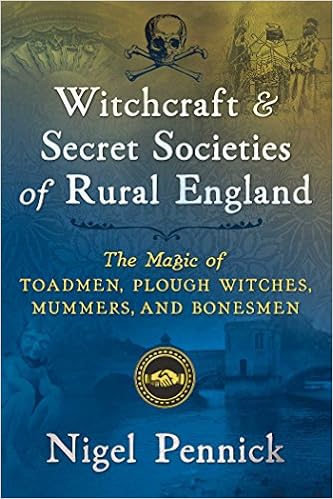
Book Review: Witchcraft and Secret Societies in Rural England by Nigel Pennick


I don’t quite know where to begin with Nigel Pennick’s Witchcraft and Secret Societies in Rural England, except to say that I really enjoyed it. It’s not like any other book I’ve ever read, and I suppose it did have its limitations, but in a bizarre way it was fun and I learned a lot. 


The book’s a bit of a slow starter. It’s almost a quarter of the way through before we actually got to any secret societies and witchcraft, and much of the opening was taken up with a detailed description of the area of eastern England on which the book is focussed. Some might find that frustrating. I didn’t. I found it completely fascinating, and the book took me longer read than it might have done because I was busy looking up all the places in Google Maps. (That’s  good thing, by the way.)

When we got into the meat of the book, it was intriguing. Some might find the rituals of Plough Monday and the secret initiation rituals of the Horsemen, never mind the magic spells of the toadmen, to be irrelevant in this day and age but the book contains a wealth of information on traditional rural ways. 

Two things about it astonished me. The first was how long these traditions persisted in parts of East Anglia — right up until the early part of the last century in some cases — and the second was how many apparently unconnected pieces of knowledge already in my head fell into place as I read. 

If the book lacked anything, it was a slightly more rigorous examination of exactly how the rural witches managed to hoodwink their contemporaries — for example, the author makes a reference to certain substances being used to stop horses in their tracks but doesn’t go into detail — but other than that it was an absorbing and enriching read. I’m not sure it’s the book for everyone, but if you’re interested in traditions then yes…you’ll enjoy it as much as I did.

Thanks to Netgalley and Destiny Books for a copy of this book in return for an honest review. 

Thursday, 11 April 2019

Book Review: Wakenhyrst by Michelle Paver

On a long train journey over the weekend I sat down with Michelle Paver’s Wakenhyrst, and I devoured it at one go.

There. That’s probably all you need to know but I feel I ought to make a bit more of an effort to tell you what I loved about it, and the book certainly deserves it. It’s a complex, compelling, dark, twisted, wonderful, readable book.

It’s set in the early part of the twentieth century and it’s the story of Maud, a child when the story begins. Stuck in a house on the edge of the fens with a wealthy but eccentric father, an irritating younger brother (who, being a boy, is granted seniority) and a long-suffering mother whose endless pregnancies almost all seemed destined to end in miscarriage or death, Maud has a grim coming of age.

I quote from the blurb. “When [her father] finds a painted medieval devil in a graveyard, unhallowed forces are awakened. Maud's battle has begun. She must survive a world haunted by witchcraft, the age-old legends of her beloved fen – and the even more nightmarish demons of her father's past.”

There was so much to love about this book. The sinister fenland with its lingering spirits is drawn as a place that would drive anyone mad. Even Maud, a practical young woman, begins to believe in evil things that creep around the corridors of Wake’s End, the house, at night. The characterisation is wonderful, the story telling extraordinary, so that I was drawn into it and just kept reading and reading and reading.

If there was one thing I didn’t like about it, it was the prologue and epilogue that brought the story into the 1960s. Yes, there was information there that tied up the loose ends of the story, but I didn’t feel it was necessary and slightly weakened the whole thing for me. Not much, though, and certainly not enough to stop me recommending it to anyone looking for a darkly satisfying read.

Thanks to Netgalley and Head of Zeus for a copy of this book in return for an honest review.